Glenna Trail
The CallerGlenna Trail is the forest route Hannes Bosch and his son Theo take on a walk toward Snellevann. The path is introduced after a narrow road shared with logging traffic and soon leads through woods, past a crossroads and St Olav’s Spring, to the water. Along the way, its hazards, signs, and natural features shape the walk into a lesson in how to move through a place that is not simply a human playground: the forest is also habitat, workplace, and pasture.
Route and Setting
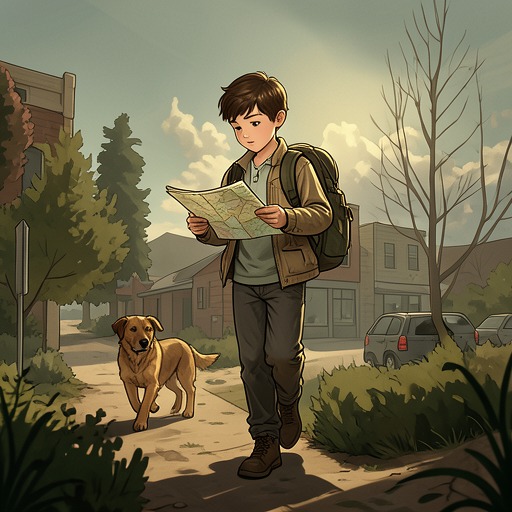
The approach begins on the main road, where the traffic is heavy with logging vehicles and the road is narrow and winding. Hannes keeps Theo on the side nearest the shoulder, a small but deliberate precaution that establishes the walk as both an outing and a responsibility. After fifteen minutes, they reach Glenna Trail; shortly afterward, they arrive at a metal barrier. Three cars stand in an uneven row in the small car park nearby, a concrete sign that other visitors have come to the same wooded area.
The trail carries them away from the road and into a forest landscape. Hannes briefly turns off the path, stepping among the trees with Theo following cautiously; later, father and son return to the trail with walking sticks. After another fifteen minutes they reach a crossroads marked by several maps and a request from the county. They continue past St Olav’s Spring, where they drink, and then walk for forty minutes to Snellevann. The sequence gives the route a clear progression—from traffic and barrier, into branching woodland paths, onward to a spring, and finally to the lake—without reducing it to mere distance or navigation.
Caution and Attention on the Trail
The walk is shaped by practical warnings. Before the outing, Wilma calls after them to watch for adders. At Glenna, Hannes reminds Theo that snakes may be nearby and points out that sandals are not sensible footwear for the conditions. He also notes that the sun will set soon. His cautions are not abstract: they arise from the terrain, the time of day, and the pair’s immediate choices as they set out.
Hannes presents the woods as a place that demands careful conduct. He imagines a moose watching them from behind the trees and says that they are in its territory, so they should not shout or behave as though the forest belongs to them. This turns the possibility of encountering wildlife into a principle of respectful movement. When he leaves the trail and Theo thinks he hears a rattling sound, Theo watches each step cautiously. The sound is not confirmed as an adder or any other animal; the uncertainty itself makes the forest feel like a place where attention matters.
Hannes’s improvised walking sticks continue that mixture of seriousness and play. He cuts a larger, thicker stick for himself and a smaller one for Theo, describing them as support and as something to fence with if they meet a mad cow. His joking warning does not erase the practical gesture: both walkers carry something suited to moving through the woods, while the difference in stick size reflects their different ages and roles on the walk.
A Shared Woodland
At the crossroads, the county’s notice describes the forest as pasture for animals, a workplace for loggers, and a place for recreation and pleasure, asking visitors to be considerate of others. The sign broadens the meaning of Glenna Trail. The woods are not reserved for the hikers’ experience: animals feed there, people work there, and visitors seek enjoyment there. Theo reads the notice aloud, and he and Hannes nod before continuing. The moment makes the request part of their passage through the landscape rather than a detached rule posted at its edge.
That shared use is already present in the walk’s details. Logging traffic marks the road leading to the trail; the warning about adders and Hannes’s talk of moose acknowledge animal life; the car park and county notice place the father and son among other users. The forest is therefore not simply a scenic backdrop for their conversation. Its uses and inhabitants set conditions for how they travel through it, and the notice gives those conditions an explicit civic form: visitors should make room for others.
The Trail as Father and Son’s Journey
Hannes guides Theo through the route by combining instruction with imaginative play. He talks about finding food and water, warmth and shelter in the woods, and pictures a life shaped by hunting, felling trees, and building a house. Theo nods, and his father’s account transports him to a magical place. The trail becomes a setting in which a practical walk can briefly open into a child’s imagined world, without the narrative losing sight of the real road, footwear, daylight, and route ahead.
Their closeness is made visible at the end of the walk to Snellevann. They sit on a rock and look across the water; Hannes puts an arm around Theo’s shoulder and draws him close, telling him they are lucky to be together. Theo agrees. He feels his father’s strength and hears the woods and the life around them. Glenna Trail thus holds together two kinds of attention: awareness of the forest as a place with its own inhabitants and uses, and awareness of the bond between the two walkers. The path’s significance rests in that conjunction. It takes them through a landscape that asks for humility, while giving father and son a shared route, a series of small lessons, and time beside the water.